
Build Your Search Engine Optimization Plan

This article covers the top SEO best practices you need to know for 2026 to improve a website’s search engine ranking. Implementing SEO best practices can increase a website’s visibility and attract more organic traffic.
How Can a Good SEO Plan Work For Your Business Website?
- SEO best practices aim to improve a website’s search engine ranking.
- Implementing SEO best practices can increase a website’s visibility and attract more organic traffic.
- Understanding user search intent is the top ranking factor.
- High-quality content directly addresses the needs and search intent of your target audience.
What is Search engine optimization (SEO)?
SEO is the process of improving the quality and quantity of website traffic to a website or a web page from search engines. Content marketing is a strategic approach that involves creating high-quality, engaging, and shareable content to attract and retain an audience, driving web traffic and supporting SEO best practices. SEO targets unpaid traffic (known as “natural” or “organic” results) rather than direct traffic or paid traffic. Unpaid traffic may originate from different kinds of searches, including image search, video search, academic search, news search, and industry-specific vertical search engines. To optimize images for SEO, use descriptive filenames and image alt text, which help search engines crawl and understand your images. Search engines crawl websites to index content, and using your primary keyword and target keyword in content, headers, and images helps improve visibility in search results. A secure, encrypted connection (HTTPS) is now a crucial SEO best practice for user trust and search engine preference. In 2026, SEO best practices have shifted to prioritize optimizing for user intent and content authority. (credit to Wikipedia)
It is crucial to make sure your business has a robust online presence. For website owners, understanding seo basics is foundational to building visibility and success online. One of the important steps for your digital marketing plan is to be aware of and use search engine optimization (SEO) best practices. Choosing a content management system with built-in SEO features can greatly simplify the optimization process for website owners.
What is the difference between off-page and on-page SEO?
Off-page SEO (also known as off-site) refers to all of the activities that you and others do away from your website to raise the ranking of a page with search engines. This type of search engine optimization includes social media marketing (Facebook, Twitter, Linkedin, Instagram, etc), Google My Business pages, link building, media coverage, articles about your business, appearing on podcast, guest blogging on other websites, local citations, etc.
Building backlinks, though, is really at the heart of improving your off-site SEO.
On-page SEO (also known as on-site SEO) is the art of optimizing your website pages and posts to improve their search engine results ranking or SERP. You might also hear this called technical SEO. On-page search engine optimization is critical to make sure website pages, titles, tags, content and overall structure are optimized for your industry’s niche target keywords. A clear keyword strategy—including the use of keyword variations and long tail keywords—helps build topical authority and search visibility. Avoid keyword stuffing and maintain natural-sounding content to prevent search engine penalties. Also, avoid duplicate content across multiple pages to prevent internal competition.
Here is a list of the 9 top SEO strategies to improve your organic search engine performance and online reputation.
- Link building – One of the most important digital marketing strategies is to increase the clean backlinks that point to your website. Focus on acquiring quality links from reputable sites and reputable websites, as links from other sites should be relevant and authoritative. The quality of backlinks matters more than quantity. There are at least two great ways to generate real, quality backlinks from respectable sites. (1) Press Releases: the first is to do regular press releases. Once those releases are search engine optimized and have relevant links in the releases back to pages on your website, you can distribute them via an electronic wire service – list of press release companies here. Sites like Business Wire and PR Newswire will share your press release with all major (and minor) news outlets, all of which have website versions and post content like yours on a regular basis. This generates highly respected links back to your site, thus improving your offsite search engine optimization. Please note that you will need to set aside funds in your marketing budget to account for these costs BUT it is well worth it! (2) Guest Blogging: another way to create quality inbound links and improve offsite SEO is to guest blog. This requires you to reach out to blogs that your prospects are already reading. Not sure which these blogs are? Go to Google and type in “guest blogs” and your “industry”. The result will be a number of blog links for your prospects. If you’re going to leverage this tactic, be sure to always post only truly useful, truly compelling, truly unique content. Earning backlinks and mentions from other brands is especially powerful for gaining visibility and authority.
- Keyword Research – Keywords are at the foundation of good website search engine optimization and improved search engine rankings. A successful online marketing strategy needs to include keyword research and implementation. If nobody is searching for what you’re writing about, you won’t get traffic from Google – no matter how hard you try. Research starts with thinking about how potential customers might be searching for your business or website. Use keyword research tools to expand on those ideas and find even more keywords. Some of the top keyword research tools include Moz Keyword Explorer, Semrush, Keyword Surfer, Wincher, Google Search Console. Effective keyword research balances search volume with relevance and conversion potential, and targeting lower search volume keywords can help you compete in less crowded spaces. Identify relevant keywords and phrases your audience uses, including long-tail variations, to attract more qualified traffic.
- Create Quality Content on a Consistent Basis – Content is the reason people visit your website and is the magnet that will keep them on your website. Make sure your content answers the why and how your can help a potential client. This can be called the value proposition. Be sure to use images, videos, infographics or other visual resources. It is possible to create high-quality content without having to resort to images or other resources but if something is clear is that the visual content has a greater impact on the user. It helps attract natural links, encourage sharing on social media and increase the time spent on the page. Write compelling page and blog post titles that will grab the readers attention. For example, instead of a title like “Improve Your SEO” this article is titled “Top 9 Tips to Build Your SEO Strategy”. Be creative and have fun! The best SEO companies will tell you to enjoy your writing, speak honestly and in a natural language that people can understand and write about your industry niche as often as possible. Surfer SEO is a tool designed to help SEO-optimize written content, like blog posts and articles. Surfer SEO offers organic keywords to help boost the quality of your content so that it can compete favorably with those of your competitors. It’s worth a look. Relevant content that answers user questions and aligns with search intent is prioritized by search engines and improves engagement.
- Reduce Your Website’s Load Time. … run a free page speed test on website page speed tools like GTMetrix and Pingdom. A good way to improve your search engine optimization is to understand you website page speed load time. Google and other search engines will ding you if your website takes too long to load. And, of course, a potential client will leave your site quickly if they have to wait to long for your website to show. Use tools like Google PageSpeed Insights to analyze and improve your site speed, as site loading speed is a confirmed ranking factor.
- Fix Broken Links – make sure you know when a link on your website is broken and fix it fast. A good WordPress plugin to use for this is Broken Link Checker.
- Featured snippets – stand out in search engine results pages (SERP) by aiming for featured snippets. Featured snippets are what search engines use to display an answer to a query directly on the SERP, so a user doesn’t need to visit another page to get the answer to their question. The image below answers the question “What is SEO”.
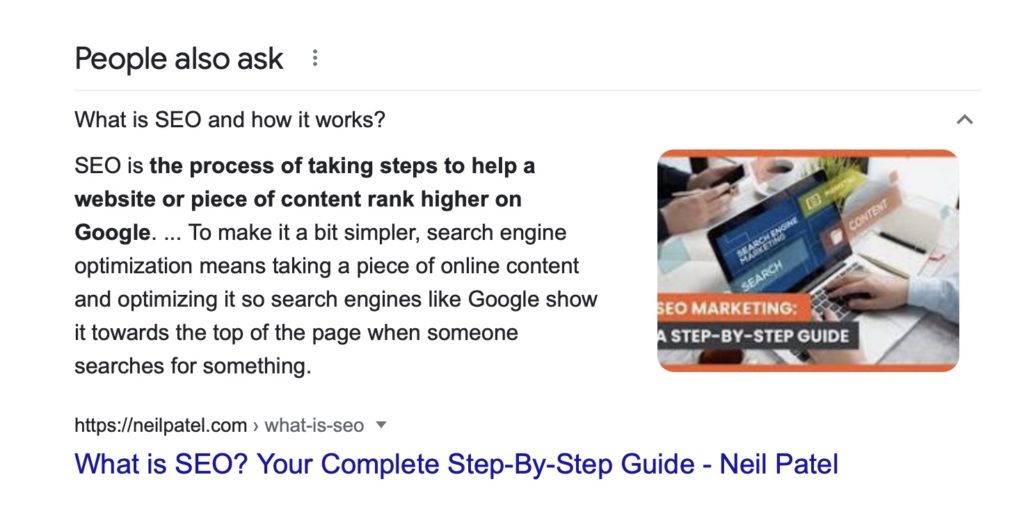
You can see the question and answer without actually clicking on a page. create posts that answer specific questions your readers may have.
- Update old pages if they don’t perform well – If a post or page is a bit drab be sure to research related keywordsto add to your content. Related keywords are useful for your digital marketing campaign because they further explain the content of the webpage. This way search engines can better understand, classify, and rank the page AND it helps explain your content better to the reader. Overall, your business SEO rankings will improve identify because variations of phrases that searchers may be using to find content related to a topic will improve your overall search rankings. Adding images, infographics, podcasts and videos with good text explanations will also aid in your search engine optimization results. Regularly updating content signals to search engines that your content is still relevant. Additionally, create new pages as needed and link from older to newer pages to boost internal linking and authority.
- Create and update your Google My Business page – Google My Business is now known as Google Business Profile but it works the same way. Any good SEO consultant will point you to this free google service that can catapult your online presence. This free tool was created by Google to help business owners manage how they appear in Google search results and on Google Maps. You can claim your free local business listing on Google and add things like your contact information, business hours, photos, services, and much more. Google My Business link.
- Run a Website Audit – this could have been listed in the #1 spot because often times a website audit should be the starting point for an effective digital marketing strategy. There are several good places to get started with a free website audit – HubSpot Website Grader, SEMrush.
Be sure to also pay attention to:
Internal Links and Site Structure
Internal links are essential for improving site structure, crawlability, and user navigation. Use descriptive, keyword-rich anchor text for internal links to help search engines understand the context and relevance of linked pages, and to guide users through your site. Link relevant pages within your site using this strategy to build authority and establish topic relationships. Organize pages logically with a clear hierarchy, use header tags (H1-H6), and group similar pages into directories for better structure.
- On-Page Elements – Optimize the page title and title tag with the primary keyword, and craft unique, compelling meta descriptions under 160 characters that include relevant keywords. Meta descriptions should be benefit-driven to encourage clicks. Use header tags to organize content and include primary and secondary keywords where relevant.
- Image Optimization – Use descriptive filenames and image alt text to improve accessibility and search rankings. Optimizing images for SEO can help your pages rank higher in search results.
- Technical Soundness and Accessibility – Ensure your website is technically sound, including mobile-friendliness, HTTPS, and responsive design for all devices. Follow accessibility guidelines, as they often overlap with SEO best practices.
- Content Authority and Trust – Include detailed author bios with credentials and cite credible sources to establish trust and differentiate your site. Use structured data (JSON-LD schema) to help search engines and AI models understand your content and the relationships between entities. Use tools like llms.txt to guide AI agents to important data and actions.
- Ongoing Optimization – Track key performance indicators (KPIs) and stay updated on algorithm changes. Promote content across platforms to increase visibility and authority. Regular maintenance, review, and enhancement strategies keep content ranking, engaging, and driving results long-term.
Keyword Research: Laying the Foundation for Success
Keyword research is the cornerstone of any successful search engine optimization SEO strategy. By understanding the exact words and phrases your target audience types into search engines, you can tailor your content to match their search intent and boost your visibility in search engine results pages. Start by brainstorming topics relevant to your business, then use tools like Google Search Console to uncover which search queries are already bringing visitors to your site. Expand your research with dedicated keyword research tools to find relevant keywords, assess their search volume, and gauge competition.
Effective keyword research goes beyond just finding popular terms—it’s about identifying the specific keywords that align with your audience’s needs and your business goals. By weaving these relevant keywords naturally into your content, you help search engines understand what your web pages are about, improving your chances of ranking higher in search engine results. Remember, the goal is to create content that resonates with your target audience and answers their questions, setting a strong foundation for your overall SEO strategy.
Technical Optimization: Ensuring Your Site Performs
Technical optimization is a behind-the-scenes powerhouse for search engine optimization, ensuring your website is easy for search engines to crawl, index, and rank. A well-optimized site structure helps search engines understand your content, while fixing broken links and optimizing page speed can lead to better search engine rankings and a smoother user experience.
Start by reviewing your site’s core web vitals—metrics that measure loading performance, interactivity, and visual stability. Make sure your images are optimized for fast loading and always include descriptive alt text, which not only helps search engines but also improves accessibility for screen readers. Implement structured data to give search engines additional context about your content, making it easier to appear in rich search results.
Don’t forget to ensure your website is mobile-friendly and uses HTTPS for a secure connection, both of which are now essential for search visibility. By prioritizing technical SEO and regularly auditing your site for issues, you’ll create a solid foundation that supports all your other SEO efforts and helps drive better search engine rankings.
SEO Tools: Leveraging Technology for Better Results
Harnessing the right SEO tools can make a world of difference in your search engine optimization journey. These tools provide the insights and data you need to refine your SEO strategy, monitor your progress, and stay ahead of the competition. Google Analytics is invaluable for tracking website traffic, user behavior, and conversion rates, giving you a clear picture of what’s working and where you can improve.
Google Search Console is another must-have, allowing you to monitor your search engine rankings, see which search queries are driving traffic, and identify any technical SEO issues that might be holding you back. For deeper keyword research and on-page optimization, consider using specialized SEO tools that help you discover new keyword opportunities, analyze your competitors, and audit your site for technical improvements.
By integrating these SEO tools into your workflow, you can make data-driven decisions, optimize your web pages more effectively, and maximize the impact of your SEO efforts. Staying proactive with the latest technology ensures your website remains visible and competitive in ever-changing search engine results.
Local SEO: Reaching Customers in Your Area
For businesses looking to attract customers in specific regions, local SEO is a game-changer. By optimizing your website for local search queries, you can increase your visibility in search results when potential customers are looking for services or attractions in your area. Start by claiming and optimizing your Google My Business listing, ensuring your business information is accurate and up-to-date.
Incorporate location-specific keywords and phrases into your content, such as “St. Petersburg vacation rentals” or “downtown St. Pete stay,” to help your site appear in relevant local search engine results. Building high-quality local citations and encouraging satisfied customers to leave positive reviews can further boost your local search engine rankings.
Creating content that highlights local amenities, attractions, and events not only appeals to your target audience but also signals to search engines that your business is a relevant choice for local search queries. By focusing on local SEO, you’ll connect with more nearby customers, increase your brand’s local presence, and drive more traffic—both online and in person.
Choosing an SEO company and/or SEO Consultant for your keyword research and digital marketing services
When it comes to creating a search engine optimization roadmap it is important to know what you will get from SEO experts. Ask for samples of reports, free audit tools and client references when you are in the search phase for a good Bay Area SEO agency. Results matter but be cautious of companies that promise an exact % increase or 100% results guaranteed. Google and other search engines are finicky and best practices change frequently. Google is reported to change its search algorithm up to 500 times each year. While most of these updates are small, every once in a while, Google releases major updates. Find a company that stays on top of these algorithm changes, communicates well and provides monthly reports so you can see what improvements are being made.
Choose an agency that can help you select or optimize a content management system with built-in SEO features, as this can simplify ongoing optimization. It’s also important that the agency demonstrates a clear keyword strategy and a strong content marketing approach to drive measurable results. In 2026, Google’s E-E-A-T framework is the primary driver for ranking, so ensure the agency helps you demonstrate expertise, authoritativeness, and trustworthiness in your content. Ask if they recommend including detailed author bios with credentials and professional affiliations to establish trust and credibility with your audience.
Reinhardt Designs is a women-owned and operated boutique digital marketing agency based in the San Francisco Bay & Tampa Bay Areas. Our SEO experts can provide a powerful roadmap to take your business to the next level. Our SEO services are geared towards small businesses that are looking for one-to-one services your can trust. Let us help you create a digital marketing plan that works for your and your industry. Contact Reinhardt Designs today to get started.
In summary:
- SEO best practices aim to improve a website’s search engine ranking.
- Implementing SEO best practices can increase a website’s visibility and attract more organic traffic.
- Understanding user search intent is the top ranking factor.
- High-quality content directly addresses the needs and search intent of your target audience.

SEO Frequently Asked Questions
How long will it take for my website to start appearing in search engine rankings?
There is not an exact time period for websites to start appearing in Search Engine results. It could vary from a couple of days to a month, and some website owners report even longer times. However, there are certain actions you can take in order to make your site more friendly to search engines focusing on its content and the technical aspects, which have been mentioned in this article.
How many keywords should I focus on per page?
Choose one primary keyword. For each page, you want to target one primary keyword. It’s okay to try and target three or even five keywords on one page, but choose one to be the primary.
Any secondary keywords can help shape your content. You can use them to create sections in your content by inserting the secondary keyword in a subheading and then in the paragraphs directly below it. The rest of the article, however, would be optimized for the primary keyword.
What is a 404 error?
In more complex terms the 404 Not Found error message is a HTTP standard response code indicating that the client was able to communicate with a given server, but the server could not find what the requested resource.
Anytime you enter a URL into the browser a request is made on your behalf:
- The request is routed through the internet to the domain on the URL (e.g. www.techcrunch.com).
- The domain is converted to an IP.
- Your request goes through to that IP address.
- Once it reaches the computer on that IP address there is a web server listening.
- The web server will look for that resource and if it does not find it will send back a 404.
If you find 404 errors on your website be sure to fix them immediately too avoid negative results/ranking from Google and other search engines.
Does my company need SEO?
Yes, your company needs SEO to help with online reputation management. It’s helpful to envision all of your site’s visitors as a large pie. On average, half of that entire pie would come from Google and other search engines. A local SEO consultant can help!
These search engines act as discovery tools which internet users utilize to find solutions to their problems. Your site could be a resource which is used by these visitors. After you create a rapport with visitors to your website, you’ll be able to direct more traffic from alternative sources (i.e. social media, email, etc.). Although your pie will eventually become more diverse, search engines will always comprise a large majority of your site’s overall traffic.
SEO Mistakes to Avoid
Things to pay attention to:
Keyword stuffing, duplicate content, ignoring meta tags, not optimizing for local SEO, etc.
Read our blog post “Top SEO Mistakes to Avoid” to learn more.